Beyond masking: sound therapy and CBT tools for tinnitus

Tinnitus Toolkit combines research-based sound therapies with CBT-style tools to support tinnitus management, based on peer-reviewed techniques.

Explore four research-informed sound approaches, guided CBT exercises, frequency matching and progress tracking.

Get it on Google Play
QR code to download Tinnitus Toolkit on Google Play
Scan on Android
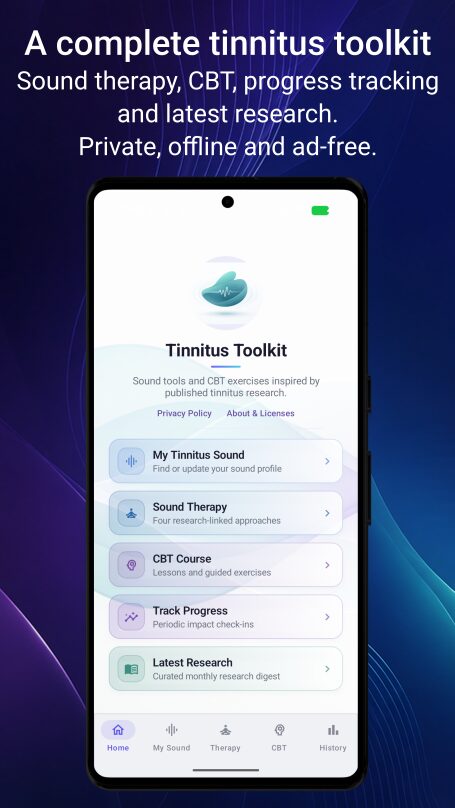
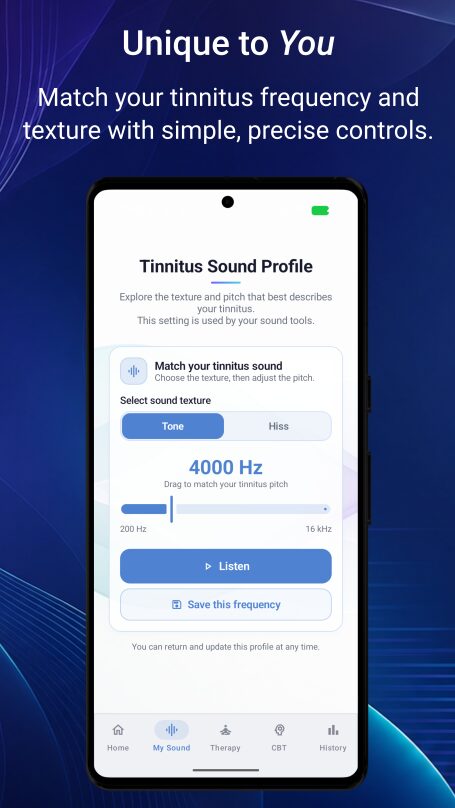
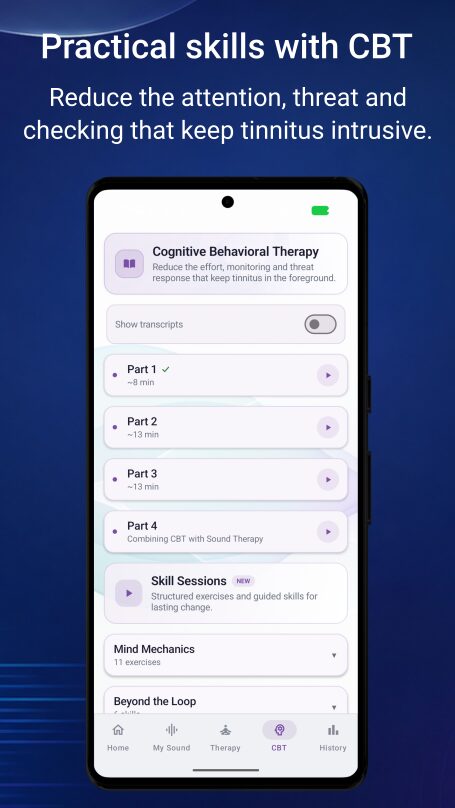
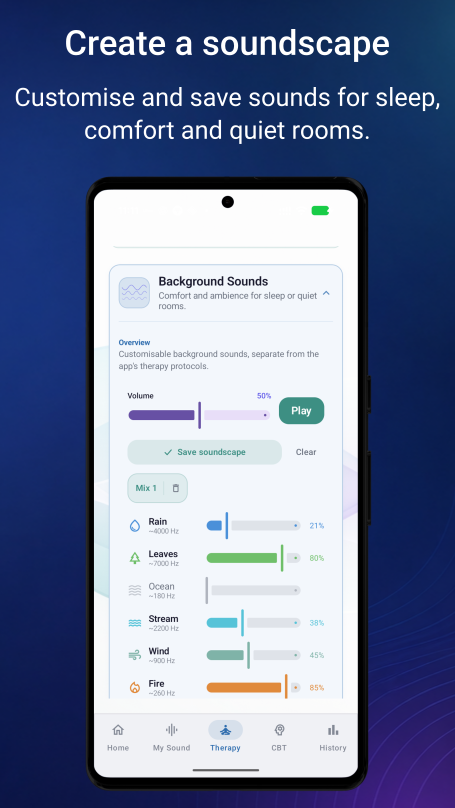
Tinnitus Toolkit home screen Sound therapy selection screen Tinnitus sound profile and frequency finder History and progress tracking screen CBT course screen

Key Facts About Tinnitus

Understanding the condition is the first step toward managing it.

No Cure — But It Can Be Managed

The brain can learn to filter tinnitus out. Most people who manage it well have simply stopped noticing it.

CBT exercises help retrain attention

Sound Therapy Works

Targeted sound may reduce tinnitus perception over time. Four research-based therapies, each targeting the auditory system differently.

4 therapies included

Your Frequency Matters

Tinnitus has a pitch — usually 4–12 kHz. Therapy works better when it's matched precisely to yours.

Find yours with the frequency matcher

Complex Triggers

Noise exposure, stress, jaw tension, certain medications. Knowing your triggers helps you manage flare-ups.

Hearing profile personalises EAE therapy

Your Daily Routine

Combine focused treatment with background therapy

SMR icon
FOCUSED SESSION ~1 hour

SMR Therapy

Dedicated treatment time. Headphones on, minimal distractions. Let the modulated tones work on neural synchrony.

Neural retraining Active listening
Background therapy icon
BACKGROUND THERAPY While you work, relax, or wind down

Choose One Sound Therapy

EAE icon
EAE
Adaptive to hearing
Band gap therapy icon
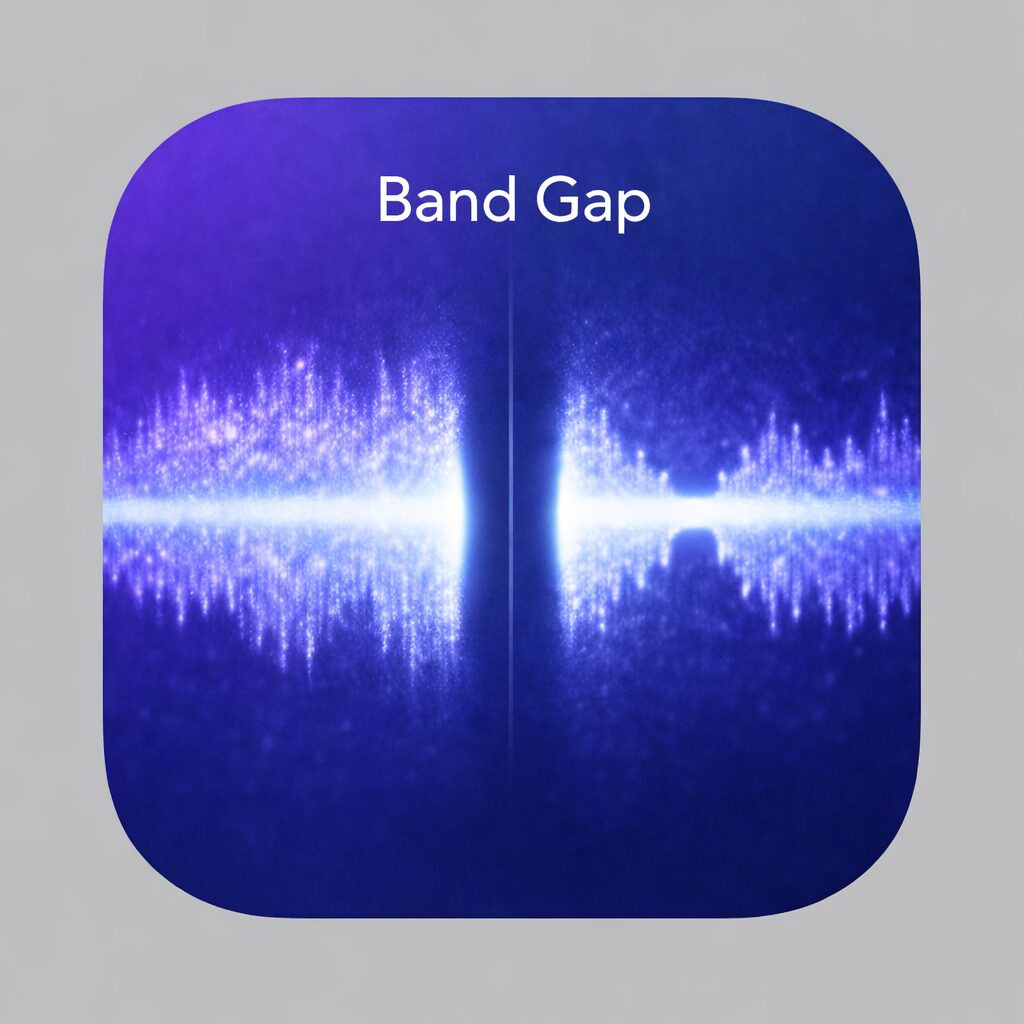
Band Gap
Removes your frequency
Flanking Band icon
Flanking Band
Bands around your frequency
💡 Pick one and stick with it for 4+ weeks
CBT icon
MENTAL TRAINING Separate from sound therapy

CBT Course & Exercises

Change how your brain responds to tinnitus. Work through the course at your own pace, then use exercises as scheduled practice — not as a response to symptoms.

Course: 3 parts
Skill sessions & exercises
Progress tracker icon
MEASURE YOUR PROGRESS Every few weeks

Evaluate Your Progress

The built-in THI questionnaire tracks how tinnitus affects your daily life over time. Retake it every few weeks and see how your score changes.

25 self-reported questions
Score trend tracked in History
Self-reporting questionnaire — for personal tracking only
🎧
Use headphones
🔈
Comfortable volume
📅
Stay consistent

Sound Therapies

Brief, referenced summaries — for orientation and further reading.

Enriched Acoustic Environment (EAE)
EAE therapy icon
  • What it is: Low-effort enriched sound exposure for daily listening.
  • Target: Tinnitus handicap.
  • Study size: 82 participants.
  • Conclusion: Meaningful reductions in tinnitus handicap over 4 months.

Band Gap Sound Therapy

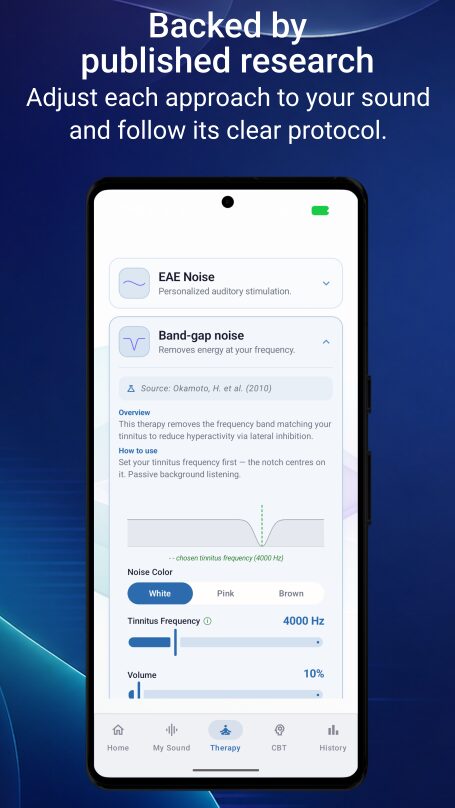
Band gap noise
  • What it is: Broadband noise with a narrow gap around your tinnitus frequency.
  • Target: Perceived loudness.
  • Study size: 23 participants.
  • Conclusion: Target listening group reported lower tinnitus loudness over time.
  • What it is: A user-adjustable take on flanking band stimulation — two noise bands positioned either side of your tinnitus frequency, inspired by this approach.
  • Target: Tinnitus handicap.
  • Study size: 184 participants.
  • Conclusion: Customised listening group reported greater reduction in tinnitus handicap vs control.

Cross-Frequency De-correlating Modulation

De-correlating modulation therapy icon
  • What it is: Patterned sound designed to reduce tinnitus-linked neural synchrony.
  • Target: Perceived loudness.
  • Study size: 77 participants.
  • Conclusion: Active modulation conditions were associated with lower loudness vs sham.
Summaries are based on published studies and are provided for orientation and further reading. Results vary between individuals.